6 Questions To Ask a Turnkey Fire Alarm Services Provider
- Does one contract cover design, installation, inspection, repair, and monitoring?
- Are your technicians licensed in every state where we have property?
- How do you track which NFPA 72 edition applies at each site?
- What is tested at each interval, and how do we get the records?
- Which of our sites still send alarm signals over copper phone lines?
- Can you show us a portfolio-wide compliance report today?
Key Takeaways
- Scope in writing: "Turnkey" should mean one agreement covering design, installation, inspection, testing, repair, and monitoring, with one account contact.
- Code editions vary by site: NFPA 72 adoption timelines differ by jurisdiction, so ask how a provider tracks the edition and amendments at each property.
- Records are your compliance: The owner is responsible under NFPA 72, so the provider's documentation needs to be complete and easy to retrieve for any site.
- Check the signal path: Identify which sites still monitor over copper lines and plan the move to IP or cellular before a carrier sets the deadline.
Most fire alarm services contracts get compared on price and response time. For a facilities director responsible for several buildings, the more useful questions are about scope, documentation, and how well a provider handles a portfolio rather than a single site. The seven checks below focus on where multi-site contracts tend to fall short. That usually isn't at signing. It's in year two, when the schedule and the paperwork have to hold up.
Why the Provider Matters as Much as the Equipment
Fire alarm technology is mature and well standardized. What varies is how consistently a system is maintained, documented, and monitored after installation, and that depends on the provider. In 2024, U.S. fire departments responded to an estimated 119,500 non-residential structure fires, which caused roughly $3.6 billion in direct property damage, according to the NFPA. Keeping alarm systems properly maintained and monitored is the part of fire protection an owner has the most direct control over.
For multi-site organizations, the challenge is rarely one bad system. It's uneven service. One property is on a tight schedule with clean records, while at another the last inspection report takes a week to track down. The real value of a turnkey provider is consistency across the whole portfolio, and each check below is a way to test for it.
1. Confirm What "Turnkey" Covers in The Contract
"Turnkey" gets used loosely. At minimum, it should mean one agreement covering design, installation, inspection, testing, maintenance, repair, and monitoring. It should also come with one account contact who knows your properties.
Ask to see how each of those services appears in the contract itself, not just the proposal. If monitoring is subcontracted, ask who the monitoring company is and who you call when a signal issue comes up. If repairs are quoted separately after each inspection, ask how deficiency pricing works so you aren't approving every fix one line item at a time.
The standard to hold any provider to is simple. When something needs attention at any property, you should know who is responsible without looking it up. Impact Fire's fire alarm services cover design through monitoring under one relationship, which is the scope a portfolio client should expect.
2. Verify Technician Qualifications in Every State You Operate
Fire alarm work is licensed at the state level, and some cities add their own requirements on top. A provider that is well credentialed in one region may not be licensed to work in another. Ask for the licenses held in each state where you have property. Also ask what share of technicians hold NICET certification in fire alarm systems, the most widely recognized credential for this work.
Local rules deserve a direct question too. In New York City, fire alarm inspection, testing, and service must be performed by an FDNY-recognized company, and the technicians doing the work need their own FDNY Certificates of Fitness, so a state license alone isn't enough there.
Manufacturer training matters as well. A technician can be fully licensed and still unfamiliar with the specific panel in your building, and that shows up as longer service calls and repeat visits. The better answer is a provider with factory training on the platforms you already own.
3. Test Code Knowledge Across Jurisdictions
NFPA 72 is the fire alarm code almost everywhere, but each jurisdiction decides when to adopt a new edition. The 2025 edition came out in early 2025, and adoption timelines vary by area. Some places adopt it within the year, others years later. That means a portfolio across three states could be working under two or three editions at once, plus local amendments.
Ask candidates how they track which rules apply at each site. Then ask for a real example of a local requirement they caught before an inspection. A specific answer means they have a process. A vague answer about "staying current" means it depends on which technician shows up.
This matters most during renovations and upgrades, when new work has to meet the current edition and the local fire marshal will look closely.
4. Get the Inspection and Testing Schedule in Writing
Vague language like "routine maintenance" is one of the most common gaps in fire alarm contracts. NFPA 72's Chapter 14 sets different inspection and testing intervals for different components, from weekly to annual. One visit a year won't cover it all. The contract should spell out what happens at each interval, who does it, and which checks your on-site staff handle. If you're not sure what a full visit should include, here's what to expect during a fire alarm inspection and test.
Documentation matters just as much. Under NFPA 72, the building owner is responsible for inspection, testing, and maintenance. That work can be handed to a qualified provider through a written agreement, which means your provider's records become your compliance records. The 2025 edition also tightens documentation requirements, including clearer role definitions and more detailed completion records.
Before signing, ask three questions. How are reports delivered? How are deficiencies tracked until they're fixed? How quickly can you pull three years of records for any one site?
5. Review the Monitoring Setup, Including the Communication Path
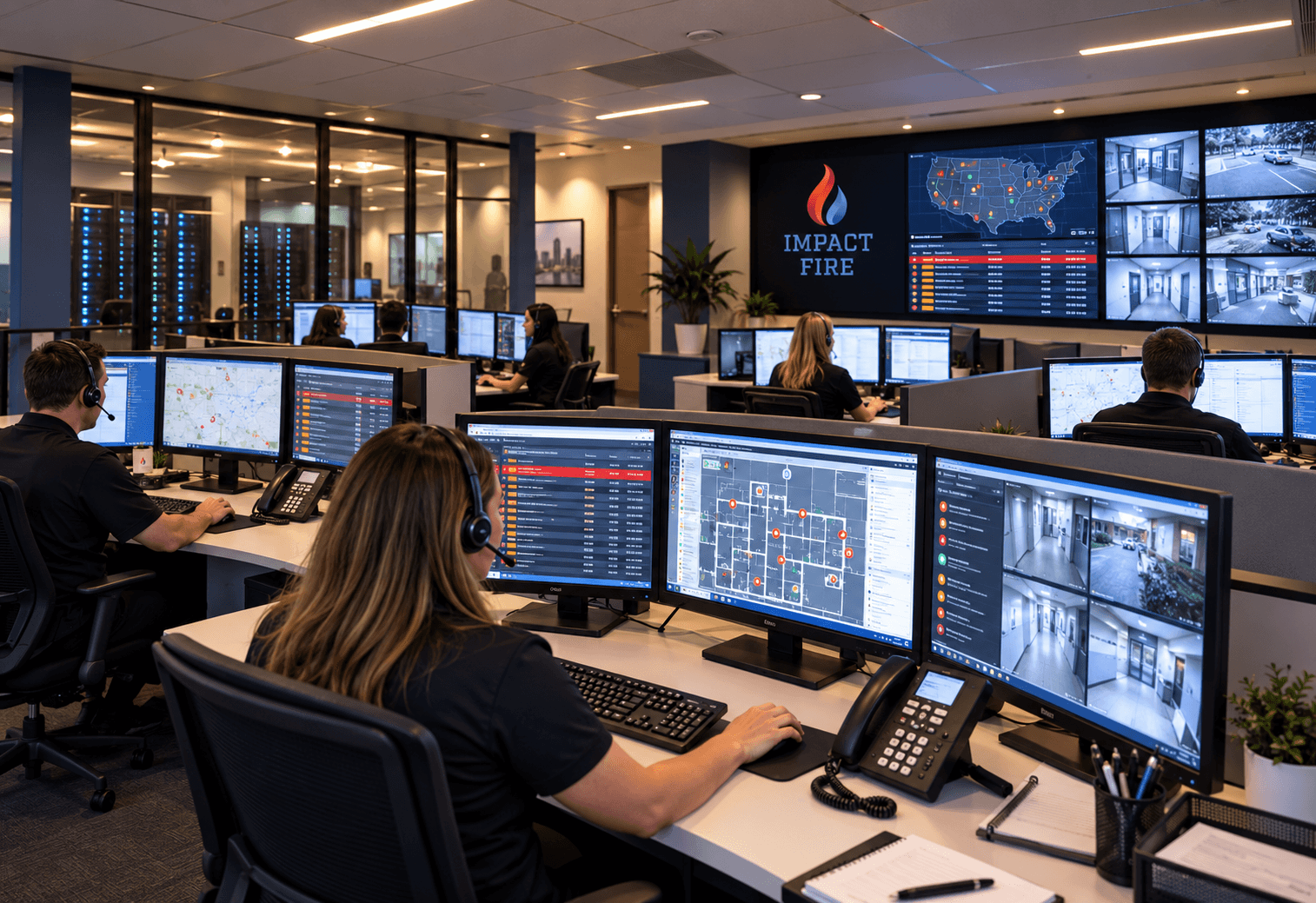
Monitoring is what turns a detected alarm into a dispatched response. Ask whether the provider's central station is UL-listed and how redundancy is built in. Impact Fire runs two redundant central stations, so customers can be switched from one to the other without a break in service. It's a useful benchmark when comparing central station monitoring options.
The communication path at each building deserves a closer look too. Many older panels still send signals over copper phone lines, which carriers are retiring. The 2025 edition of NFPA 72 includes significant changes related to communications technologies, along with expanded cybersecurity requirements. Ask the provider to identify which of your sites still rely on copper. Then ask for a plan to move them to IP or cellular transmission on your timeline rather than a carrier's.
Finally, ask for verification and dispatch procedures in writing. This overview of what central station monitoring covers is a helpful reference for those conversations.
6. Confirm They Can Report Across Your Whole Portfolio
The last check is about your own workload. Ask whether the provider can produce one report showing every property's status. It should show which sites are current, which have open deficiencies, and which inspections are due in the next 90 days. Ask whether that report comes from a customer portal or has to be compiled by hand from each local office.
Ask how account management works across locations, too. A provider with a national footprint should be able to assign one account lead who coordinates the local teams, so you aren't managing each branch as a separate vendor.
If a provider can't show you a sample portfolio report during the sales process, it's unlikely to get easier after onboarding.
Choosing Turnkey Fire Alarm Services for Multiple Properties
The right provider answers all six checks with specifics, from scope and licensing to monitoring and portfolio reporting. Contact the fire safety experts at Impact Fire to review your properties and build a fire alarm services plan that fits your portfolio.